
1450 Emerson, Avenue, Suite 202, McLean, VA 22101
ABOUT US | A HISTORY OF THE SOCIETY | OUR ARTISTS | THE APPLICATION PROCESS | OPENING PAGE
| 2003 Recitalist |
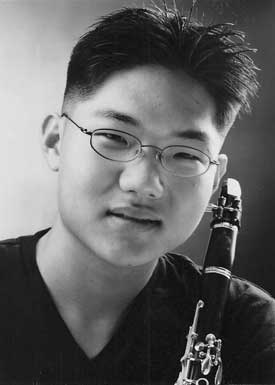 Clarinetist Won-Jin Jo will perform on September 27, 2003, 7:30 p.m. at the Terrace Theater, John F. Kennedy Center for the Performing Arts, Washington, D.C.
Won-Jin Jo, born in Flushing, New York, was 16 when he was named a winner of the 2001 New York Philharmonic Young Artists' Competition. He subsequently made his New York Philharmonic debut at a Young People's Concert in 2001 under Kurt Masur. He was re-engaged for a five-concert tour with the New York Philharmonic in 2003 under Roberto Minczuk. In May 2003, Mr. Jo was named a Presidential Scholar in the Arts, and in June 2003 he performed at the "Salute to the 2003 Presidential Scholars" at the Kennedy Center Concert Hall. He was awarded the coveted Presidential Medallion at a White House ceremony in addition to being honored by the Korean Embassy.
Mr. Jo started playing piano at the age of five and clarinet at the age of nine. He made his orchestral debut at the age of eleven with the Queens Symphony Orchestra. He has since performed at Carnegie Hall, Avery Fisher Hall, Merkin Hall, and Alice Tully Hall. He has also been featured in National Public Radio's "From the Top" and the "Today Show" on NBC.
Mr. Jo began his musical training at the Pre-College Division of the Juilliard School of Music where he studied with Alan R. Kay. At Juilliard, he won the Concerto Competition in 2001 and was honored with the Distinguished Achievement Award in 2000. He won the New Jersey Young Artists' Competition in 1999 and the Queens Symphony Orchestra / Newsday Young Soloists' Competition in 1997. Mr. Jo is currently a first-year student at Harvard College.
Presents
Won-Jin Jo, clarinet
with
Noreen Cassidy-Polera, piano and  Patrick Jee, Cello
in 24th Annual Washington Debut Recital Series
7:30PM, Saturday, 27 September 2003
The Terrace Theater
The Kennedy Center for the Performing Arts, Washington, DC
Program
George Gershwin 		Three Preludes
			Allegro ben ritmato e deciso
			Andante con moto e poco rubato
			Allegro ben ritmato e deciso
Francis Poulenc		Sonata
			Allegro tristamente
			Romanza
			Allegro con fuoco
Paul Jean-Jean Carnival of Venice (Theme and Variations)
intermission
Jeeyoung Kim		Wanderlust for solo clarinet (2003)
			- the world premiere
Johannes Brahms		Trio for Clarinet, Cello and Piano, Op. 114
			Allegro
			Adagio
			Andantino grazioso
			Allegro
Ambassador Sung Joo Han will recognize and honor Professor Hyo Kang
of Juilliard School of Music for his long and outstanding contribution to
classical music in the United States before the start of the recital.
Meet the artists
Won-Jin Jo, born in Flushing, New York, was 16 when he was named a winner of the 2001 New York Philharmonic Young Artists’ Competition. He subsequently made his New York Philharmonic debut at a Young People’s Concert in 2001 under Kurt Masur. He was re-engaged for a five-concert tour with the New York Philharmonic in 2003 under Roberto Minczuk. In May 2003, Mr. Jo was named a Presidential Scholar in the Arts, and in June 2003 he performed at the “Salute to the 2003 Presidential Scholars” at the Kennedy Center Concert Hall. He was awarded the coveted Presidential Medallion at a White House ceremony in addition to being honored by the Korean Embassy.
Mr. Jo started playing piano at the age of five and clarinet at the age of nine. He made his orchestral debut at the age of eleven with the Queens Symphony Orchestra. He has since performed at Carnegie Hall, Avery Fisher Hall, Merkin Hall, and Alice Tully Hall. He has also been featured in the National Public Radio’s “From the Top” and the “Today Show” on NBC.
Mr. Jo began his musical training at the Pre-College Division of the Juilliard School of Music where he studied with Alan R. Kay. At Juilliard, he won the Concerto Competition in 2001 and was honored with the Distinguished Achievement Award in 2000. He won the New Jersey Young Artists’ Competition in 1999 and the Queens Symphony Orchestra / Newsday Young Soloists’ Competition in 1997. Mr. Jo will be a first-year student at Harvard College this fall.
Korean-born composer, who was educated in Korea and the United States, "Jacqueline" Jeeyoung Kim, was appointed as the first composer-in-residence of the Society from 2003 through 2005. She will be presenting her works in the annual recital series at the Kennedy Center and other concerts presented by the Society. The “Wanderlust for unaccompanied clarinet” was composed for Won-Jin Jo and will be premiered by Won-Jin at this recital.
She was trained in Yonsei University in Korea, Indiana University, and Yale University in the US. She won many prestigious awards and recognitions in the US. Her work has been performed frequently in the US as well as in Korea. She is considered as one of the most talented Korean born composers in her generation and one of the most active composers in the US today. Most recently, she was commissioned by the Yo-Yo Ma’s Silk Road Ensemble. Her piece, Tryst, a trio for cello, oboe, and kayagum (Korean harp) was performed by the Ensemble in the United States and Europe.
Cellist
Patrick Jee is hailed as a "gifted virtuoso" with
"...lustrous suavity and a satin-smooth bowing and singing line"
(Harris Goldsmith/New York Concert Review). He has garnered top prizes in many
competitions including the Andre Navarra Cello Competition, the
Holland-America Music Society Cello Competition and the Irving Klein
International String Competition.
As a soloist, Mr. Jee's performances include the Buffalo Philharmonic, the Rochester Philharmonic, the Chamber Orchestra of Toulouse, the National Orchestra of Toulouse and the Orchestra de Chambre Regional D'Ile-de-France. His recital and chamber music engagements have taken him across the country to venues such as the Banff Centre for the Arts, Carnegie Hall, the Norfolk Chamber Music Festival, and La Jolla's Summerfest. Mr. Jee gave the Washington debut recital at the Terrace Theater of the Kennedy Center in 2002 under the auspices of the Korean Concert Society. He has also participated in the Caramoor Music Festival's "Virtuosi" and "Rising Stars" series where he collaborated with Leon Fleisher, and Ani and Ida Kavafian.
Mr. Jee has worked with members of the Emerson, Orion, Tokyo, and Vermeer Quartets along with other distinguished artists such as Emanuel Ax, Claude Frank, Lynn Harrell, David Shifrin, Janos Starker, and Isaac Stern. He can be heard on the Albany Records label premiering a work by Ezra Laderman and has had radio broadcasts over WFMT Chicago and WXXI Rochester.
Noreen Cassidy-Polera, winner of the accompanying prize at the Tchiakovsky International competition, has established a career as a collaborative pianist that has taken her throughout the United States as well as Canada, Europe and Korea. Among the artists with whom she has appeared are Leonard Rose, Yo-Yo Ma, Antonio Meneses and Carter Brey. She has performed in New York's Alice Tully Hall, Weill Hall and the 92nd Street Y as well as the Kennedy Center in Washington, D.C. She has recorded a CD of short pieces for cello and piano with William DeRosa for the Audiofon label. For the last two years Ms. Cassidy-Polera has both taught and performed at the University of South Florida in Tampa. During the 1999-2000 season, performances included those in Utah, California, New York and Washington, D.C. Last March she performed the complete Beethoven Sonatas for cello and piano at he St. Petersburg Museum of Fine Art in Florida. This season includes performances in North Carolina, La Jolla, as well as Philadelphia and New York. She has been invited by the Festival Casals Grand Prix in Puerto Rico and the Leonard Rose International Competition to serve as an official pianist for these competitions.
PROGRAM NOTES
By Robert Massey
Francis Poulenc was, in a way, working backwards. As the leader of Les Six, he led the charge to rescue music from what he considered stuffy intellectualism. He loved to mix moments of lightness and wit with passages of sentiment and melancholy. Poulenc's Sonata for Clarinet and Piano, however, was one of his life's last works, and its elegiac tone is dedicated to the memory of his friend Arthur Honegger. The three movements demand intense concentration from players, yet they yield a sweet lyricism as well as a stately dignity. Alas, the composer passed away of a heart attack before he could see Benny Goodman and Leonard Bernstein premiere the work at Carnegie Hall.
Yet Francis Poulenc may never have come to the piece without the example set by George Gershwin. Even today the debate continues whether he was a classical or popular song composer. His appreciation for jazz paved the way for Benny Goodman, Leonard Bernstein, as well as jazz-inflected composers like Maurice Ravel. Ragtime, blues, gospel and jazz were not off limits to Gershwin. Nor were the European classics. "It seems to me beyond doubt that Gershwin was an innovator," proclaimed none other than Arnold Schoenberg, Gershwin's frequent tennis partner in Hollywood.
While Gershwin rarely wrestled with large-scale forms - one hallmark of the classical composer - his mastery of smaller forms, such as the Three Preludes, brought him a great deal of influence and attention in classically-conscious but jazz-hungry Europe. The two outer pieces are quick and last only a minute or so. The middle Prelude is three minutes of blues. Yet they all display the tight melodic logic of all great music, classical or popular.
Johannes Brahms was inspired enough by a clarinetist to write for him. In 1891, on a weeklong visit to Meiningen, Germany. Brahms heard Richard Muehlfeld. Eight moths later, Brahms returned bearing two new works for clarinet, one of which was the Trio for Clarinet, Cello and Piano.
It's a gentle, lyrical piece full of delicate textures yet displaying possibly the widest emotional range of all Brahms' chamber works. The clarinet supports the cello almost as much as it takes the melodic lead. A simple arpeggio and descending scale opens the piece. The uncomplicated sonata form builds into a thicket of counterpoint. The adagio is gentle yet not without its darker moments. The third movement is a nostalgic waltz which gathers steam into the virtuosic gypsy-flavored rondo finale.
Paul Jeanjean's variations on Carnival of Venice is no less virtuosic but a lot more fun. It's a variation on a tune everyone has heard many times - from a child's windup toy. Yet the demands on the clarinetist are anything but light: in certain passages two clarinet lines come from one instrument. The piece requires a sly sense of humor in addition to impeccable form. After all, playing a children's song in concert would seem a little backwards, until one encounters the technical fireworks demanded by Jeanjean's tune.
"Wanderlust"
By Jeeyoung Kim
"Wanderlust" is a German word for enthusiasm for travel. Our lives are in some way "travel"; we do not know what to expect, and what we should do is to be patient, to do our best, and to enjoy whatever happens. When the Korean Concert Society invited me as its first composer-in-residence, I thought about the Korean Concert Society, Won-Jin Jo, and myself. The common things are youth, Korea, America, and dreams, and I wanted to celebrate them.
Musically I tried to inject the spirit of Korea. The main idea comes from how the Korean traditional music is constructed; the beauty of Nong-Hyun (fluctuation of one note for ornamentation). For example, I applied Nong-Hyun by having many flourishing fast notes around one note to exaggerate it. Sometimes there is no melody, but the whole section becomes one melody. The piece consists of four sections: first, flourishing ornaments with center tone and exploring the center pitch with neighboring ornamental notes as the idea of Nong-Hyun; the second, retrospective lyrical Korean style melody played by using Korean way of making vibrato and glissando; the third, the amalgam of these two as a metaphor of cultural synthesis; and the fourth, sublime triumph of music itself in Korean shamanistic rhythmic pattern.
Ironically, the more I live away from Korea, the better I understand Korea. In my experience, what I find is that in my composition, I am able to synthesize the diverse elements of my life.
ABOUT US | A HISTORY OF THE SOCIETY | OUR ARTISTS | THE APPLICATION PROCESS | OPENING PAGE